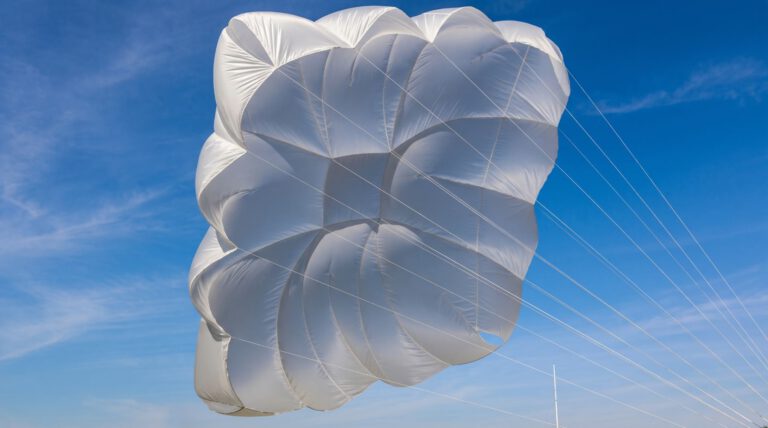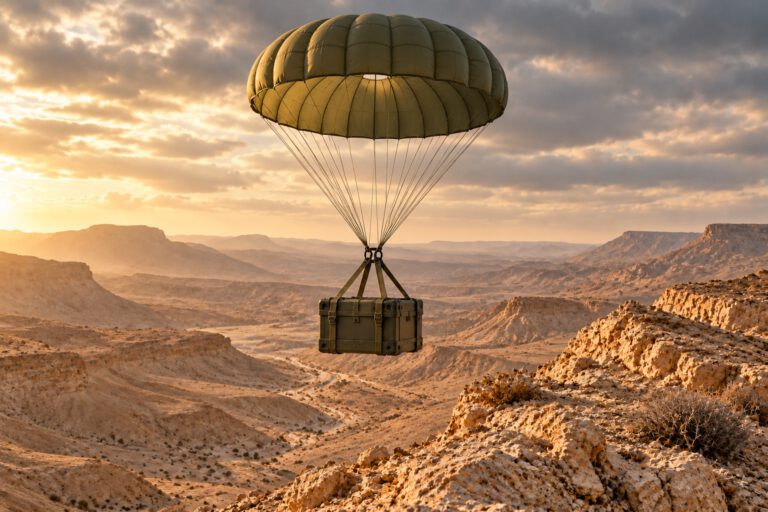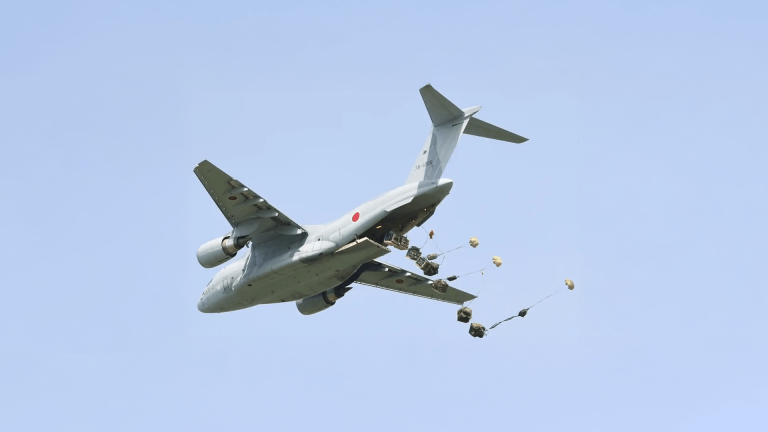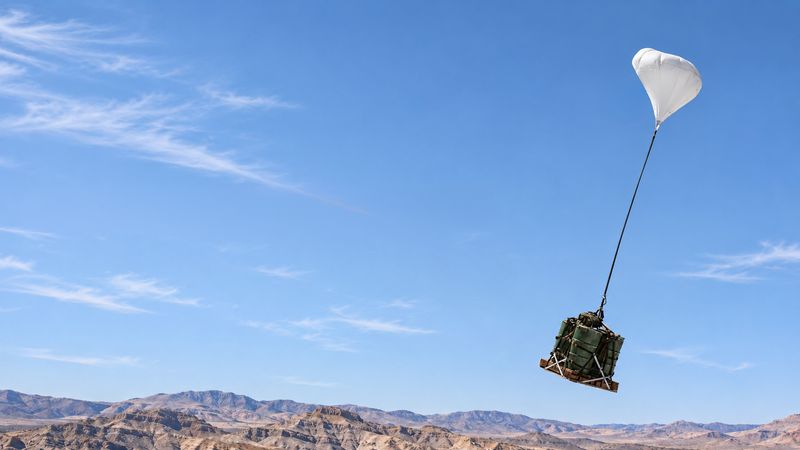
The minimum HALO parachute opening altitude for a UAV or payload is the lowest height at which the main canopy can begin deploying, bring the platform into controlled descent, and leave the required clearance for recovery. It depends on the speed and attitude at deployment, the canopy’s inflation sequence, and the loads the platform and payload can tolerate.
APCO Aviation Defense UAV recovery textile solutions are designed around those constraints. For a planned high-altitude, low-opening profile, the central question is how much height the system needs after it commands main deployment.
What does HALO parachute altitude refer to?
In high-altitude military parachuting, HALO stands for High Altitude Low Opening. The parachutist exits at altitude and descends in free fall before deploying the parachute lower in the profile. The U.S. Air Force also uses HALO for an airdrop profile in which a period of free fall precedes parachute actuation. For unmanned recovery, the main canopy can open late in the descent even when a drogue has already deployed to stabilize the platform.
| Altitude | What it tells the engineering team |
| Exit or release altitude | Where the parachutist exits or the payload leaves the carrier. For a self-recovering UAV, define where the recovery sequence starts. |
| Main deployment initiation altitude | Where the command or mechanical event starts main-canopy deployment. |
| Altitude at controlled descent | Where the platform first meets the specified descent-rate and stability criteria under the main canopy. |
When comparing published altitudes, check which event each number describes and whether the reference is above ground level (AGL) or mean sea level (MSL). A release altitude stated in MSL does not tell you how much clearance remains above the recovery area. Likewise, a personnel deployment figure applies to its stated operation and equipment. A UAV or payload needs its own validated limit.
What determines the minimum HALO parachute opening altitude?
Start with the condition the platform must reach before landing. For example, a recovery requirement might specify a maximum descent rate, an acceptable level of oscillation, and a minimum height at which both criteria must be met. Work back from that point to allow for the height lost between the main deployment command and controlled descent, plus a margin for variation in the sequence and uncertainty in height above the recovery area.
The deployment sequence can include a delay between the command and extraction, followed by line extension, canopy inflation, deceleration, and stabilization. Useful deceleration can begin during inflation. A fully inflated canopy can also leave the platform with more downward speed or motion than the recovery requirement allows. Record when the system meets the defined recovery criteria as well as when the canopy opens.
How do airspeed and opening shock affect low-opening recovery?
Airspeed relative to the airflow and vertical speed answer different questions. Airspeed and local air density determine the dynamic pressure the parachute encounters. The vertical speed history determines how much height the platform loses while the deployment sequence runs. Two platforms can reach the same deployment altitude with different airspeeds, descent rates, and attitudes. The opening sequence has to accommodate the conditions the platform actually reaches.
How quickly the canopy develops drag matters as well. A slider or reefing system can slow inflation to manage the load transmitted through the suspension lines and attachment points to the structure and payload. The trade-off is that delaying full inflation can increase the height lost before the system reaches controlled descent. A change that lowers peak load should therefore be evaluated against the remaining height as well as the allowable load.
How does a drogue change the HALO deployment sequence?
A drogue can stabilize a descending platform and reduce its speed before the main canopy opens. In some configurations, it can also extract the main deployment bag. The engineering question is whether the drogue brings the platform into the range of speed and attitude in which the main can deploy as intended, with enough height left for the rest of the sequence.
An additional stabilization stage can be considered when the first drogue leaves too much speed or motion for the main. That stage adds another transition to validate and uses height before the main deployment command. Its effect on the minimum main opening altitude depends on the conditions it produces at main deployment and the height the main then needs to establish controlled descent.
What should a HALO parachute deployment test show?
Define what the test needs to prove before selecting the test conditions. A useful test record connects the conditions at deployment to the loads and motion observed throughout recovery. At a minimum, the test plan should address these questions.
- What conditions were tested? Record the payload configuration, platform attitude, airspeed, vertical speed, and the altitude reference.
- Where did the system use height? Track the deployment command, extraction, inflation, and the point at which the required descent criteria were met.
- Did the platform and payload stay within their limits? Compare measured loads and remaining clearance with the acceptance criteria, and document which configurations and conditions the evidence covers.
How APCO Aviation Defense approaches HALO recovery
APCO Aviation Defense develops lightweight, low-bulk defense textile solutions for staged recovery. For a HALO project, useful starting inputs include the expected speed and attitude at main deployment, payload configuration, allowable opening loads, available packing volume, and the required condition of the asset at touchdown. Those inputs help define what the drogue, main canopy, and deployment sequence need to achieve together.
The minimum main opening altitude is ready to specify when the team can identify the conditions it applies to, the recovery criteria the platform must meet, and the evidence that the sequence leaves the required clearance.