Bring your payload from high-speed descent to a stable, controlled descent with deceleration parachutes engineered for your mission.
APCO Aviation Defense works with your team to define a non-steerable solution around deployment conditions, allowable opening loads, and target descent rate.
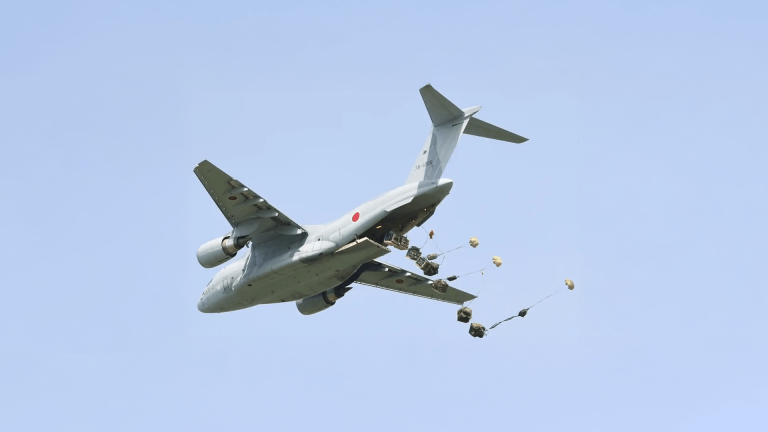
Deceleration parachutes can be deployed in several ways, depending on mission requirements:
Passive deployment – The parachute is released into the airstream and inflates naturally under its own weight as it exits a deployment bag.
Active deployment – The canopy is extracted using mechanical force, such as ballistic mortar, spring-loaded, or pneumatic ejection systems.
Assisted deployment – A smaller drogue parachute extracts the main parachute, ensuring a consistent and reliable opening sequence. In UAV recovery, a compartment door acting as a drag surface can serve a similar purpose.
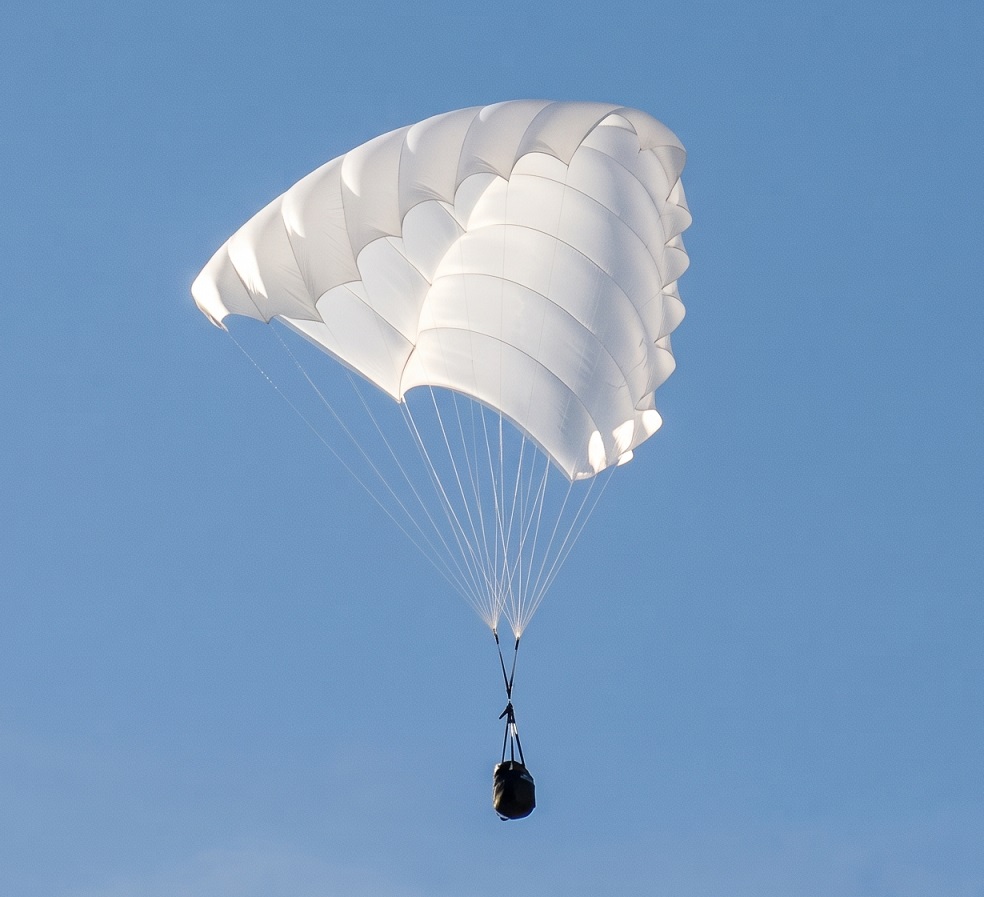
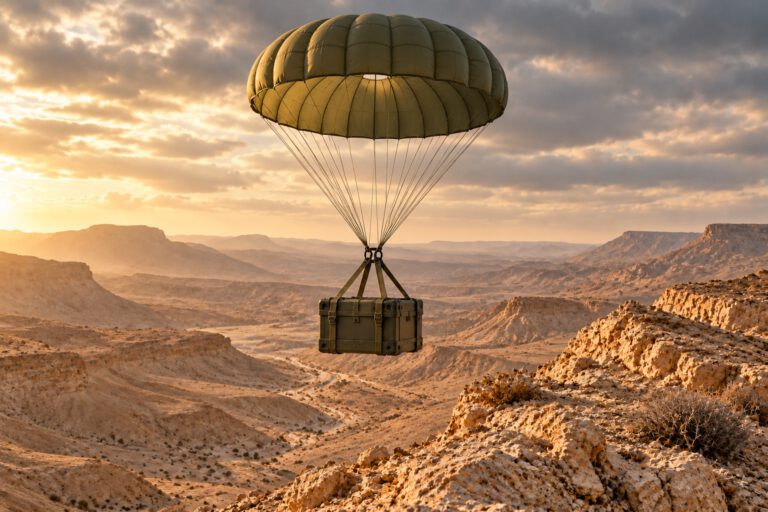
Round Parachutes
Round parachutes are among the most common configurations in both military and commercial applications.
High strength-to-weight ratio, ideal for very high load applications.
Configurations include center-line canopies, pull-down apex designs, and various conical shapes.
Performance can be tuned through pull-down apex geometry, vent size, canopy porosity, panel shaping, and slotting.
Generally slower to open than rectangular parachutes, which may be beneficial in high-load scenarios.
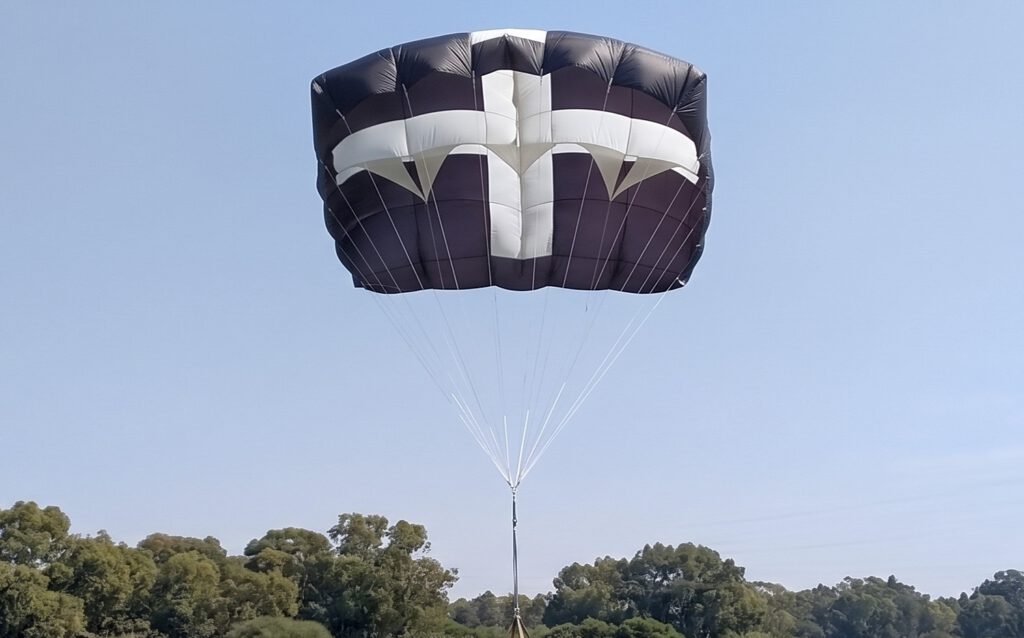
Rectangular Parachutes
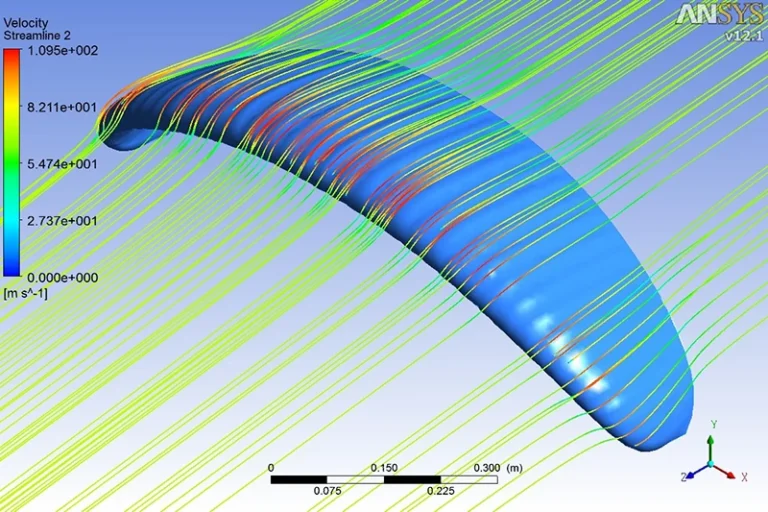
Increasingly popular for their improved drag efficiency.
Higher projected area-to-surface area ratio compared to round canopies.
Superior pendulum stability during descent, further improving the effective Cd.
Typically open faster than round parachutes, which is advantageous for rapid deceleration but can increase opening shock.
Opening Control Systems
Both round and rectangular deceleration parachutes can be equipped with reefing lines or sliders to delay full canopy inflation. This reduces opening shock loads, which is essential when working near maximum load limits.
However, designers must account for altitude loss during the delayed opening phase.
Other Specialized Shapes
While less common, several other designs are valuable for niche defense and aerospace applications:
Cross Parachutes – Stable and simple for certain cargo drop missions.
Rotating Parachutes – Generate controlled rotation for stabilization or dispersal.
Annular Parachutes – Ring-shaped canopies with unique aerodynamic profiles.
Slotted parachute – ribbon parachute including: ring slot, ring sail, disk gap band, etc.
The APCO project journey
From Requirement to Mission Readiness
We work with your team through every stage of the project to deliver reliable, mission-ready solutions.
APCO Aviation Defense works within the standards, certifications, and regulatory frameworks that support defense and aerospace programs.
ISO & AS Certifications
ITAR
EAR
DFARS
NIST
Berry Amendment
Buy American Act
Wassenaar Arrangement
Supplier Partnerships
Offset Program Support
Why APCO Aviation Defense
Lightweight recovery solutions backed by decades of aviation experience.
APCO Aviation Defense delivers lightweight, high-performance parachutes, inflatables, and recovery systems for UAVs, loitering munitions, and tactical platforms. Backed by 50+ years of aerospace innovation, we provide custom textile solutions from concept to deployment.
Mission-led definition
Solutions are shaped around what must be recovered, captured or protected.
Lightweight, low-bulk design
Compact textile solutions help reduce integration burden and support prototypes, small production runs and larger project needs without requiring large batches.
Textile engineering expertise
Net materials, deployment logic and structural behavior are evaluated for the application.
Validation mindset
Selection and development are guided by the operating conditions and the validation required.
Off-the-shelf products
Proven products for recovery, deceleration and delivery
Explore ready product options developed for lightweight recovery, precision airdrop and mission-ready integration.
Find quick answers about our solutions, capabilities, and how we work.
What is a deceleration parachute?
A deceleration parachute is designed to slow a payload from high-speed descent to a stable, controlled sink rate. It is used in defense, aerospace and UAV recovery applications where the objective is to reduce speed, stabilize the payload and support controlled descent..
Are deceleration parachutes steerable?
No. Deceleration parachutes are generally non-maneuverable systems and do not provide directional control. They descend with the surrounding air mass rather than actively steering toward a landing point.
How can a deceleration parachute be deployed?
Depending on the mission requirements, deployment can be passive, active or assisted. Passive deployment relies on the parachute entering the airstream, active deployment uses a mechanical extraction method, and assisted deployment can use a smaller drogue parachute to extract the main canopy.
What is the difference between round and rectangular deceleration parachutes?
Round parachutes offer a high strength-to-weight ratio and can be configured in several ways for high-load applications. Rectangular parachutes provide improved drag efficiency and pendulum stability and typically open faster, although faster opening can increase opening shock.
How can opening shock be controlled?
Round and rectangular deceleration parachutes can use reefing lines or sliders to delay full canopy inflation. This helps reduce opening-shock loads, although the controlled opening process also increases the altitude required for full deployment.
Why does altitude matter when controlling parachute opening?
Opening-control systems delay full inflation to reduce loads. Because this takes additional time, the payload loses more altitude before the canopy becomes fully effective. The available deployment altitude therefore needs to be considered when defining the opening-control system.
What other deceleration parachute shapes are available?
Specialized configurations can include cross parachutes, rotating parachutes, slotted parachutes and annular parachutes. Each geometry provides different aerodynamic behavior for specific defense, aerospace or cargo-drop applications.