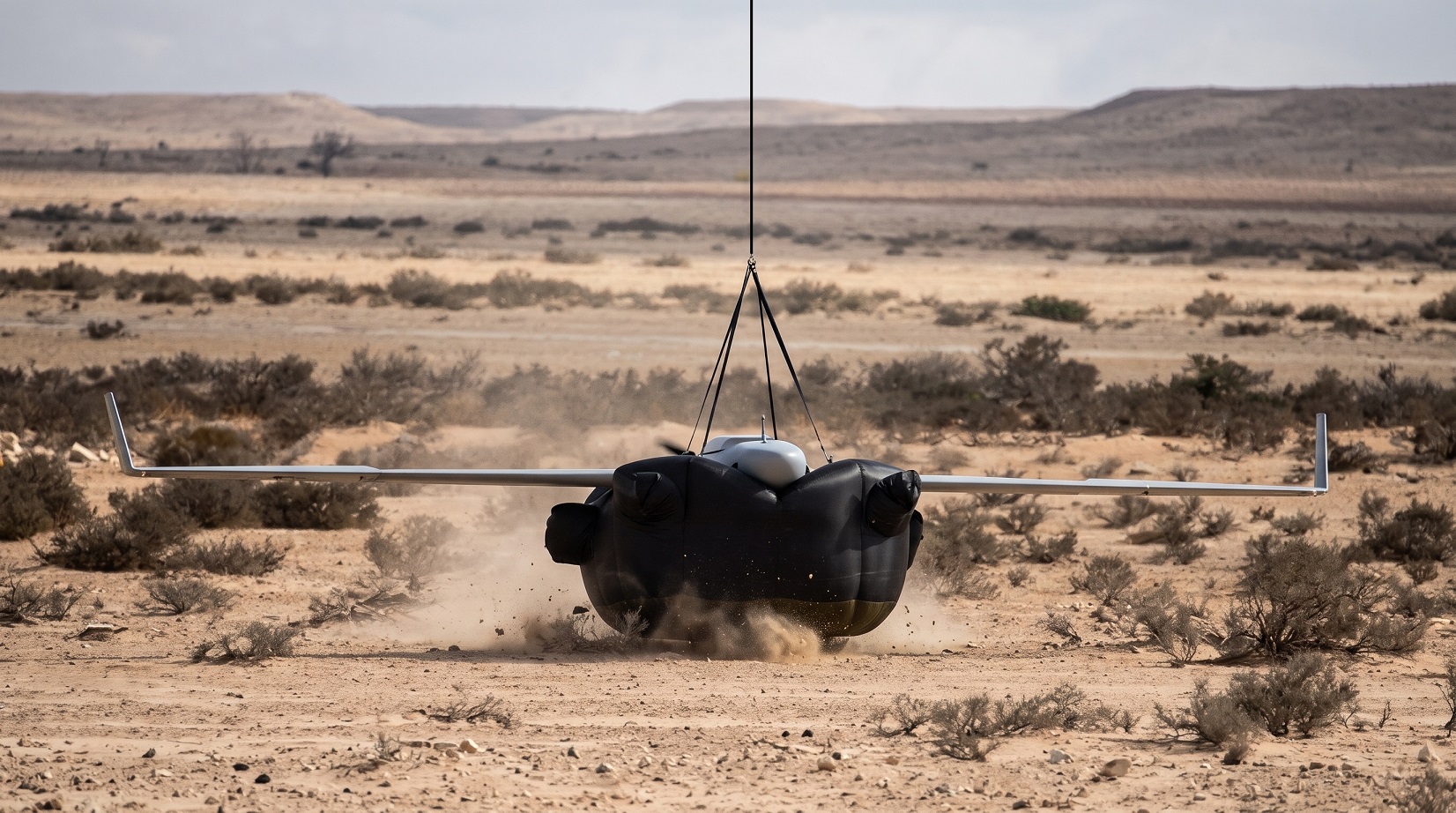
UAV airbags from APCO Aviation Defense help protect your platform at touchdown.
Designed for parachute-based landings without traditional landing gear, these inflatable energy absorption systems help absorb impact, reduce structural damage, and preserve your UAV for future missions.
For optimal efficiency, airbags should be incorporated during the initial platform design phase in close collaboration with APCO Aviation Defense. This ensures the system is matched precisely to the UAV’s structure and mission profile. They perform best when the descent is vertical and predictable.
When designed incorrectly, particularly for parachute-assisted recoveries with wind drift, the airbag may behave like a rolling ball on landing—tipping or rotating the UAV instead of properly absorbing the impact and suspending it.
Self-Inflatable Airbags
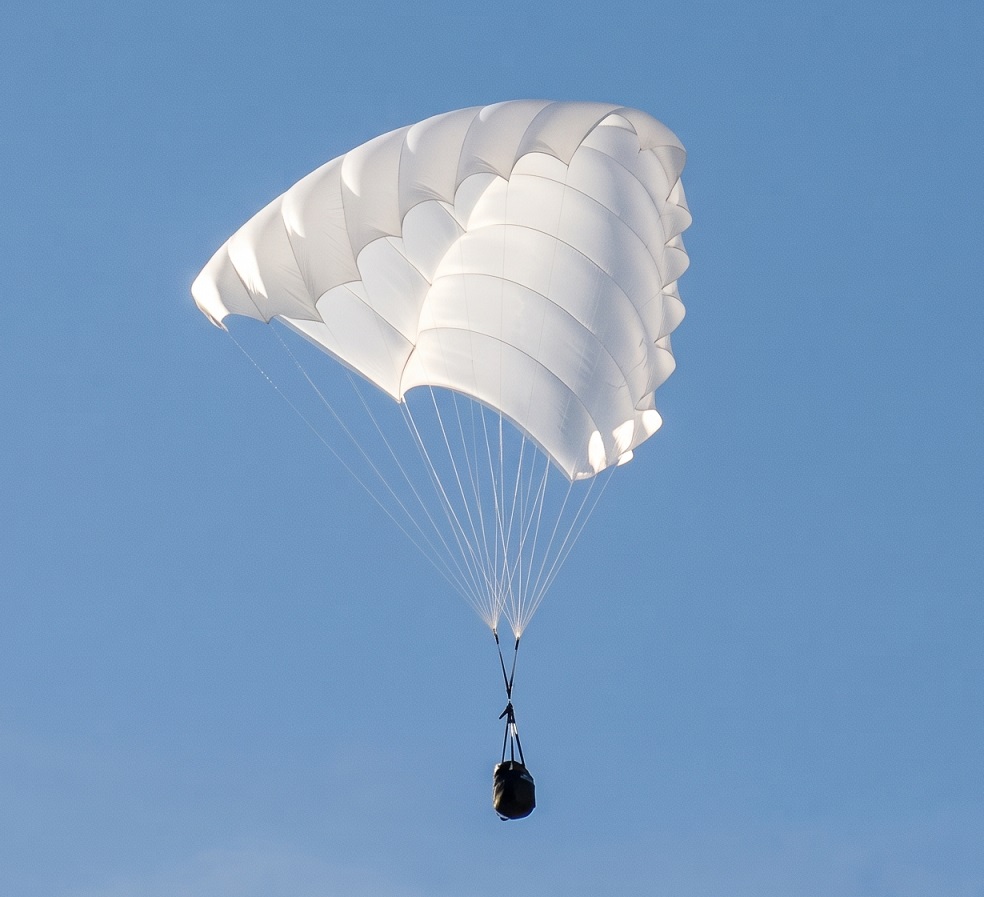
* Inflate using airflow during parachute descent.
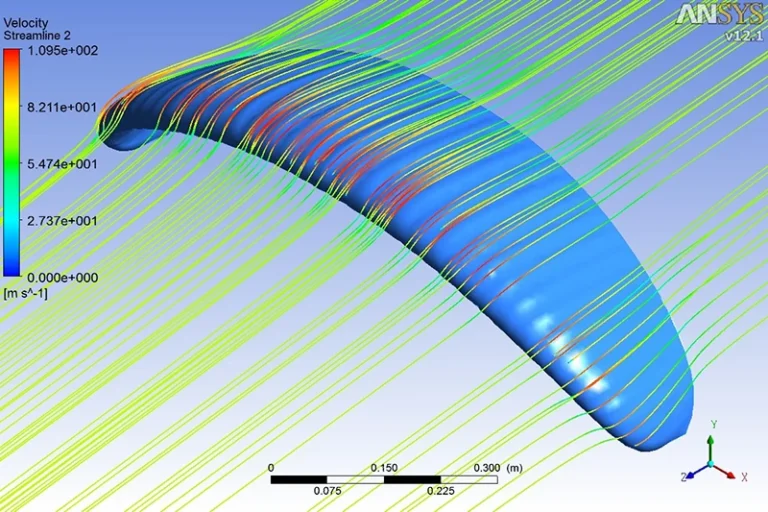
* Adapted from paragliding harness impact protection technology.
* Offers weight savings but requires more storage volume.
Fan-Inflating Airbags
* Use ducted fans for rapid inflation.
* May be combined with self-inflation valves.
* Achieves higher internal pressure and stability.
Chemical discharge Airbags
* Similar to automotive airbags.
* Fastest inflation with high internal pressure.
* One-time use, activated seconds before impact.
* Requires additional sensors and altitude measurement.
Compressed air discharge
* Similar to automotive airbags.
* Controllable inflation and pressure.
* Multi-stage activation.
The APCO project journey
From Requirement to Mission Readiness
We work with your team through every stage of the project to deliver reliable, mission-ready solutions.
Align on mission needs, operational constraints, and success criteria.
02
Design & Develop
Engineer lightweight, low-bulk solutions built around performance.
03
Test & Validate
Prototype and test to verify reliability and safety.
04
Produce & Deliver
Manufacture with quality control and timely delivery.
05
Support & Sustain
Provide documentation, training, and ongoing support.
Trust & Compliance
Trusted in Mission-Critical Environments
APCO Aviation Defense works within the standards, certifications, and regulatory frameworks that support defense and aerospace programs.
ISO & AS Certifications
ITAR
EAR
DFARS
NIST
Berry Amendment
Buy American Act
Wassenaar Arrangement
Supplier Partnerships
Offset Program Support
Why APCO Aviation Defense
UAV Airbags Backed by Recovery and Inflatable Expertise.
APCO Aviation Defense delivers lightweight, high-performance parachutes, inflatables, and recovery systems for UAVs, loitering munitions, and tactical platforms. Backed by 50+ years of aerospace innovation, we provide custom textile solutions from concept to deployment.
Mission-led definition
Solutions are shaped around what must be recovered, captured or protected.
Lightweight, low-bulk design
Compact textile solutions help reduce integration burden and support prototypes, small production runs and larger project needs without requiring large batches.
Textile engineering expertise
Net materials, deployment logic and structural behavior are evaluated for the application.
Validation mindset
Selection and development are guided by the operating conditions and the validation required.
Off-the-shelf products
Proven products for recovery, deceleration and delivery
Explore ready product options developed for lightweight recovery, precision airdrop and mission-ready integration.
Find quick answers about our solutions, capabilities, and how we work.
What is the purpose of a UAV airbag?
A UAV airbag is designed to absorb landing impact and help protect the platform from structural damage during recovery, particularly when the UAV lands using a parachute without conventional landing gear.
When should an airbag be integrated into the UAV design?
For best performance, the airbag should be considered during the initial platform design phase. Early integration helps match the airbag to the UAV structure, center of mass, available space, and expected landing conditions.
Why is vertical descent important for UAV airbags?
Airbags perform best when the descent is vertical and predictable. If the UAV is drifting significantly at touchdown, the airbag may cause the platform to tip or roll rather than absorb the impact as intended.
What types of UAV airbags are available?
UAV airbags may be self-inflating, fan-inflated, chemical or compressed air discharge inflated. The most suitable type depends on the required inflation speed, available storage volume, weight constraints, internal pressure, and mission conditions.
How do self-inflating UAV airbags work?
Self-inflating airbags use airflow during parachute descent to inflate. They can reduce system weight.
What is the advantage of a chemical or compressed air discharge inflating airbag?
chemical or compressed air discharge airbag systems provide very rapid inflation and high internal pressure shortly before impact. The chemical discharge model is typically single-use and require additional sensing and triggering components.
What information is needed to develop a custom UAV airbag?
Key inputs include the fuselage shape, critical impact zones, platform center of mass, available airbag compartment dimensions and volume, and the maximum allowable impact G-force or energy absorption requirement.
How do UAV airbags provide impact absorption during landing?
UAV airbags cushion the platform on contact with the ground, absorbing impact energy and helping protect its structure. Their design must match the UAV’s shape, center of mass, and allowable impact loads. Correct positioning also helps prevent tipping or rolling during parachute-assisted landings.