Home → Solutions → Non Guided Cargo Delivery Systems
HIGH VELOCITY DECELERATION SYSTEM
Cargo Parachute Systems for Non-Guided Delivery
Your payload. Your drop conditions. Our engineering.
Deliver essential supplies and equipment with cargo parachute systems engineered around your payload, release conditions, and landing requirements.
APCO Aviation Defense works with your team to define a cost-effective, non-guided solution – from canopy selection and deployment to post-landing cargo protection.
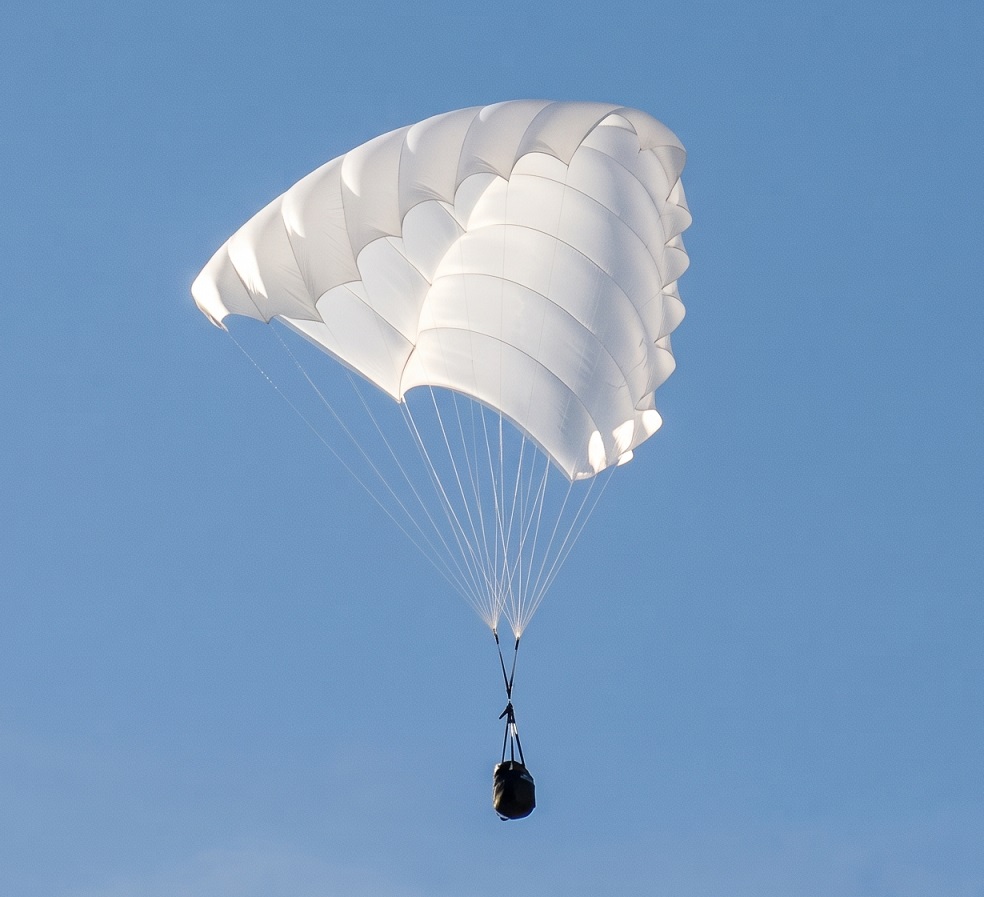
Round parachutes are most common for payloads exceeding 500 kg, as they are simpler to manufacture, inherently stronger, and highly reliable in high-load scenarios.
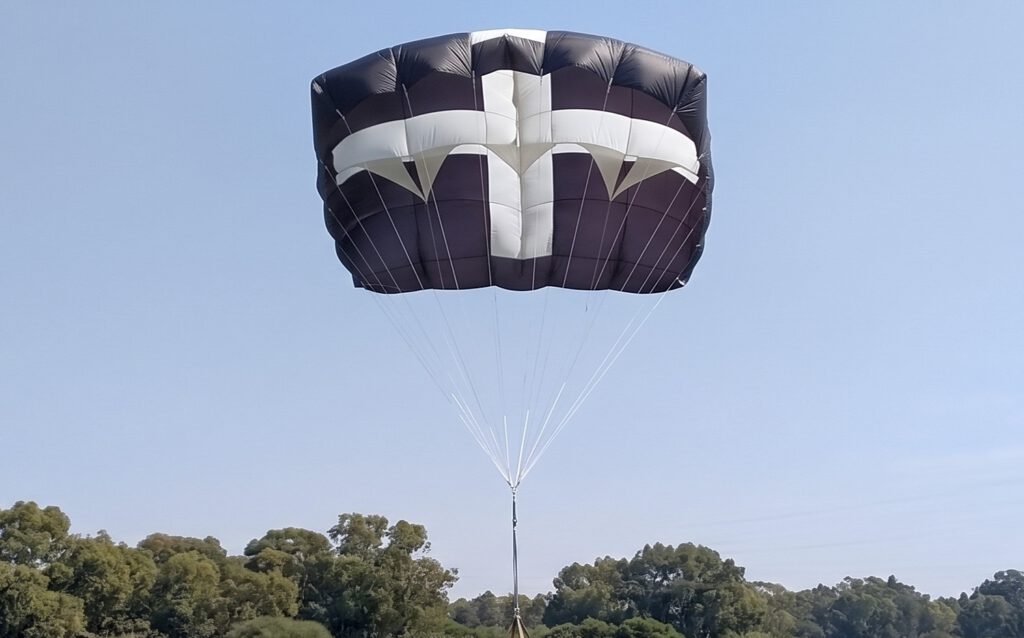
For lighter cargo, square parachutes can deliver a slower descent rate and improved pendulum stability, although they involve higher production costs.
Parachute clusters – whether round, square, or a combination—offer a cost-efficient solution by using multiple smaller, commercially available canopies. This approach allows descent rate customization by adding or removing parachutes according to payload weight and sensitivity.
Post-Landing Safety
To ensure post-landing safety, most cargo delivery systems incorporate a parachute release mechanism. This device disconnects the canopy immediately after touchdown, preventing the wind from dragging or flipping the load, and minimizing the risk of damage to both cargo and parachute.
Operational Scenarios
Non-guided cargo parachute systems are deployed in a wide range of applications:
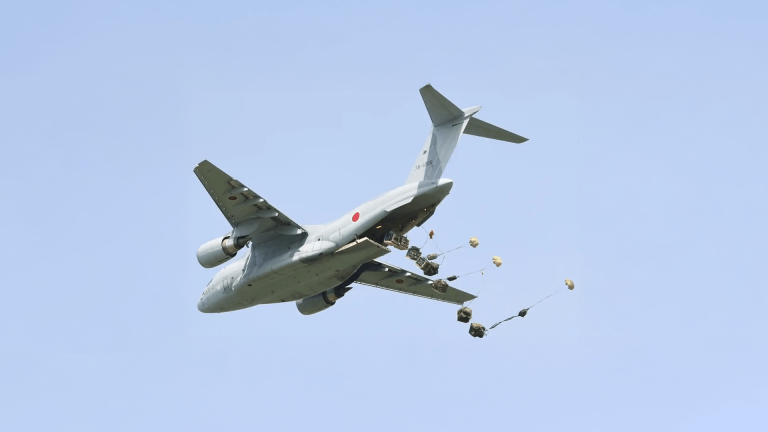
Military Resupply Missions – Delivering ammunition, rations, fuel, or medical supplies to forward operating bases without exposing aircraft to prolonged risk.
Humanitarian Aid Drops – Providing food, water, shelter, and medical kits to disaster-stricken or remote areas where ground access is impossible.
UAV and Equipment Recovery – Safely returning unmanned platforms or sensitive payloads to the ground after mission completion.
Expedition and Remote Logistics – Supporting scientific expeditions, mining operations, or offshore platforms with essential supplies.
Simple, Reliable Deployment
These systems are valued for their simplicity, reliability, and rapid deployment capability, making them an essential tool in both defense operations and civil emergency response.
The APCO project journey
From Requirement to Mission Readiness
We work with your team through every stage of the project to deliver reliable, mission-ready solutions.
Align on mission needs, operational constraints, and success criteria.
02
Design & Develop
Engineer lightweight, low-bulk solutions built around performance.
03
Test & Validate
Prototype and test to verify reliability and safety.
04
Produce & Deliver
Manufacture with quality control and timely delivery.
05
Support & Sustain
Provide documentation, training, and ongoing support.
Trust & Compliance
Trusted in Mission-Critical Environments
APCO Aviation Defense works within the standards, certifications, and regulatory frameworks that support defense and aerospace programs.
ISO & AS Certifications
ITAR
EAR
DFARS
NIST
Berry Amendment
Buy American Act
Wassenaar Arrangement
Supplier Partnerships
Offset Program Support
Why APCO Aviation Defense
Designed for Non-Guided Delivery
APCO Aviation Defense develops non-guided cargo delivery parachute systems around payload weight, descent rate, stability, deployment conditions, and post-landing safety. Drawing on more than 50 years of aviation and parachute experience, we develop lightweight defense textile solutions and parachute configurations suited to the operational requirements of each cargo delivery mission.
Mission-led definition
Solutions are shaped around what must be recovered, captured or protected.
Lightweight, low-bulk design
Compact textile solutions help reduce integration burden and support prototypes, small production runs and larger project needs without requiring large batches.
Textile engineering expertise
Net materials, deployment logic and structural behavior are evaluated for the application.
Validation mindset
Selection and development are guided by the operating conditions and the validation required.
Off-the-shelf products
Proven products for recovery, deceleration and delivery
Explore ready product options developed for lightweight recovery, precision airdrop and mission-ready integration.
Find quick answers about our solutions, capabilities, and how we work.
What is a non-guided cargo delivery system?
A non-guided cargo delivery system uses a parachute configuration selected around the payload weight, required descent rate, stability, deployment conditions, and cost requirements of the mission.
Which parachute types are used for non-guided cargo delivery?
Round parachutes are commonly used for heavier payloads because of their strength, reliability, and relatively simple construction. Square parachutes may be used for lighter cargo where a slower descent rate and improved pendulum stability are required.
Why are parachute clusters used for cargo delivery?
Parachute clusters use multiple smaller canopies rather than one large parachute. The configuration can be adapted by adding or removing parachutes according to payload weight, sensitivity, and required descent performance.
Why is a parachute release mechanism important after landing?
A release mechanism disconnects the parachute after touchdown, helping prevent wind from dragging or overturning the load and reducing the risk of damage to the cargo and parachute.
What applications can non-guided cargo delivery systems support?
They can support military resupply, humanitarian aid drops, UAV and equipment recovery, and logistics operations in remote or difficult-to-access locations..
How is a non-guided cargo parachute configuration selected?
The configuration depends on factors such as payload weight, required descent rate, cargo sensitivity, stability requirements, deployment conditions, and the balance between performance and cost.