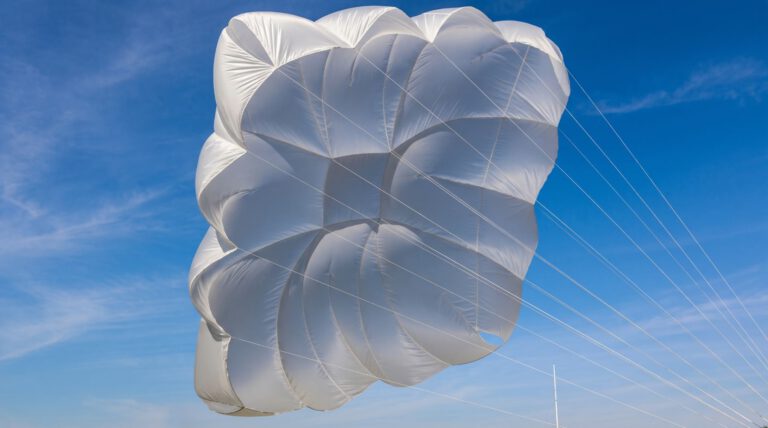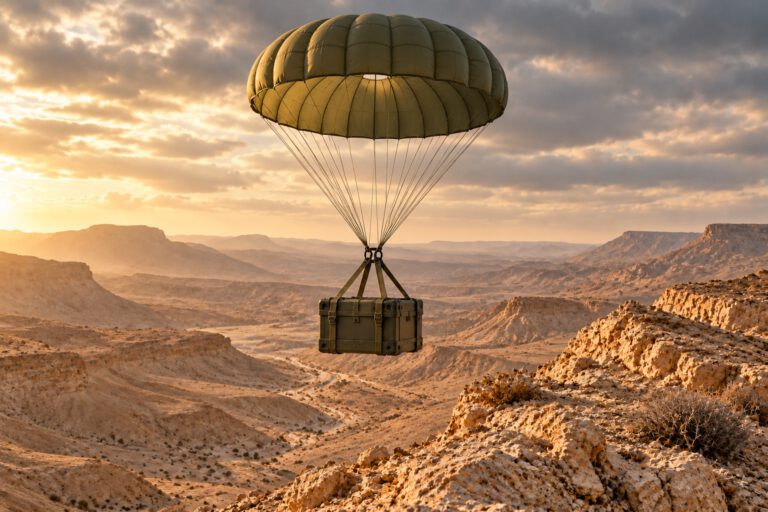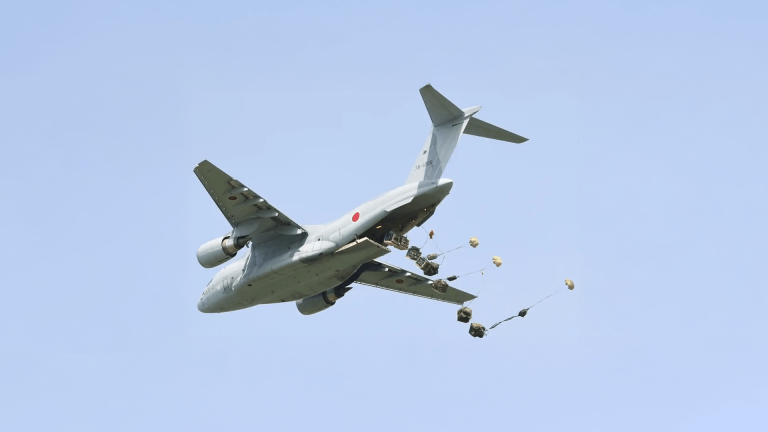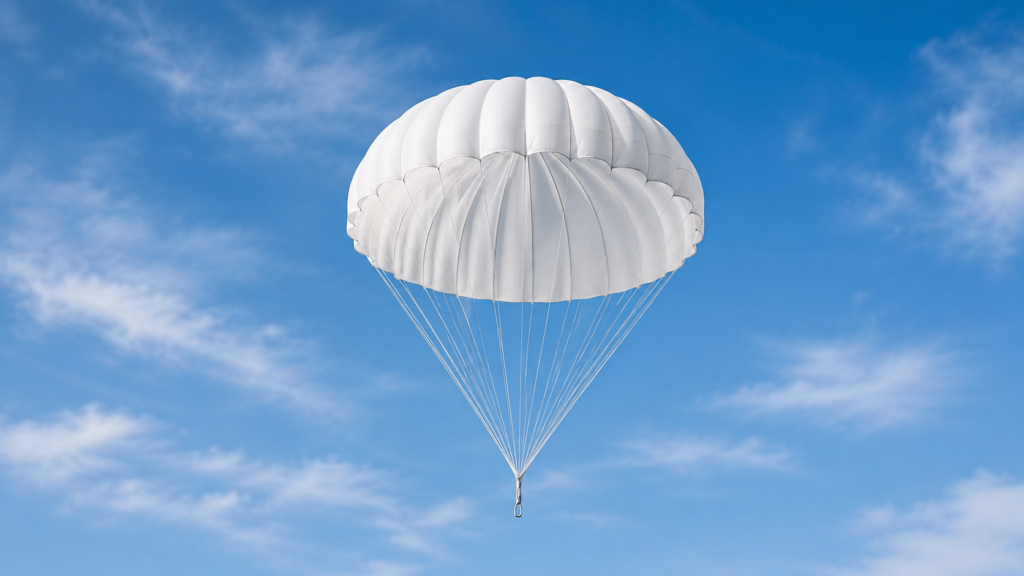
When a UAV recovery parachute opens, it must create useful deceleration quickly enough to protect the platform and payload. But the faster the canopy develops aerodynamic force, the greater the opening loads can become on the structure, attachment points and payload.
The engineering challenge is therefore not simply to make the parachute open as fast as possible. It is to control how the opening develops so that effective deceleration begins when needed without creating forces that the system cannot safely absorb.
APCO Aviation Defense UAV recovery textile solutions draw on experience from sports aviation, where parachute opening, lightweight textile construction and force control have been explored across different applications. Could that experience help us rethink how opening speed and opening shock are balanced in UAV recovery?
Let’s explore different ideas, combining experience from one world and applying it to another, to see whether that can lead us to creative recovery solutions.
Why Faster Opening Creates a New Recovery Problem
In any UAV recovery event, the timing of parachute inflation matters.
The sooner the canopy begins producing useful drag, the sooner the recovery system can start reducing the platform’s speed. But there is another side to that advantage:
As the canopy develops projected area, aerodynamic force increases. If that force develops too aggressively, the opening event itself can place significant loads on the UAV, payload, attachment points, suspension lines and parachute structure.
The technical material also shows that increasing projected area can improve drag performance while increasing the initial inflation force and opening shock.
This creates the central engineering question: How do you create the drag you need, when you need it, without transferring unacceptable loads into the asset you are trying to preserve?
From our experience the answer is not simply to make the parachute open faster or slower, but to control how the opening develops.
What Happens During Parachute Opening?
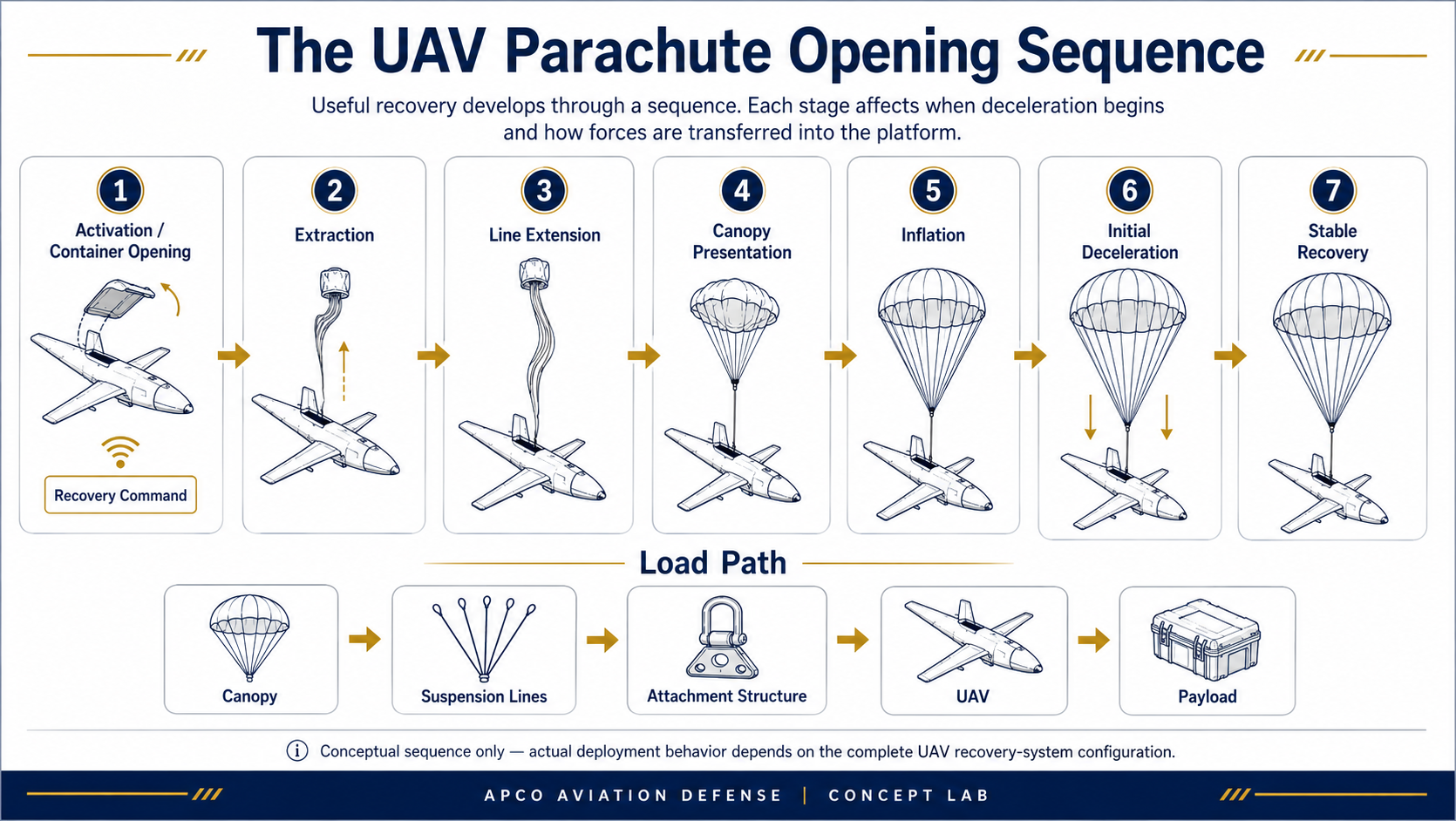
A parachute does not move instantly from packed to fully effective. The recovery event develops through a sequence.
Depending on the system, that sequence can include:
Activation -> Extraction -> Suspension-Line Extension -> Canopy Presentation -> Inflation -> Initial Deceleration -> Stable Recovery
Each stage influences when useful aerodynamic drag becomes available and each stage can also influence how loads enter the recovery system.
The extraction device, container, suspension lines and canopy therefore cannot always be treated as separate components. The available source material emphasizes that they need to work as one recovery system.
Line deployment, canopy presentation and opening-force management all influence what happens before the parachute reaches useful inflation. Rapid extraction alone does not necessarily mean rapid, controlled recovery.
Once inflation begins, the force moves through the entire load path:
Canopy -> Suspension Lines -> Attachment Structure -> UAV -> Payload
If the opening is too aggressive, the problem may not only be structural failure. The technical material also identifies the possibility of payload rebound, line unloading and secondary movement when deceleration happens too rapidly. So opening shock is not simply a parachute problem.
It is a complete-system recovery problem.
Activation -> Extraction -> Line Extension -> Canopy Presentation -> Inflation -> Initial Deceleration -> Stable Recovery
What Sports Aviation Can Teach Us About Opening-Force Control
This is where experience from another aviation world becomes interesting.
Sports aviation has spent decades working with lightweight textile structures where weight, packed volume, deployment behavior, aerodynamic performance and safety all matter.
APCO Aviation Defense brings this background from paragliding, paramotoring and lightweight parachute systems into UAV recovery and defense textile solutions. The APCO brand material specifically connects this experience with lightweight, low-bulk construction and UAV opening-shock control.
This does not mean that a sports-aviation parachute can simply be transferred onto a UAV. The platforms, loads, flight conditions, payloads and recovery requirements are different. But some of the design thinking can move between the two worlds.
One useful lesson is that parachute opening does not have to be treated as an uncontrolled transition from packed canopy to full inflation.
The opening can be influenced.
For example, the available round-parachute material describes slider-controlled deployment as a way of restricting how rapidly the canopy can initially spread.
It also describes reefing, where the parachute begins inflation in a restricted condition before progressing toward full opening after a defined event.
Other available approaches include:
- Controlled line payout
- Progressive extraction
- Multi-stage inflation
- Drogue-assisted deceleration
- Modified packing
- Controlled canopy porosity
- Changes to canopy geometry
Each changes the opening event in a different way.
And that leads to the experiment.
Experiment: Can We Shape the Parachute Opening Instead of Simply Slowing It Down?
Here is the idea we want to explore: What if opening-shock control were not approached simply as
How do we make the parachute open slower?
What if the better question were:
How do we shape the sequence so that useful deceleration starts when we need it, while controlling how quickly the full opening force develops?
That changes the way we look at the problem.
The first part of the sequence could focus on getting the parachute cleanly away from the UAV and extending the suspension lines.
The next part could begin developing aerodynamic drag.
Full canopy inflation could then develop according to the structural limits of the UAV, payload and attachment system.
The objective would be to manage how force develops over time, rather than simply choosing between a fast parachute and a slow parachute.
Different design directions could be explored.
Idea 1: Control the First Moment of Inflation
A slider or reefing mechanism could temporarily restrict the canopy as the opening begins.The objective would be to prevent the full projected area from appearing immediately while still allowing the recovery process to continue.
Idea 2: Build Deceleration in Stages
Instead of asking one canopy to create all the required deceleration at once, a drogue or another staged mechanism could begin reducing speed before the main parachute reaches full inflation.The sources specifically identify drogue-assisted deceleration and multi-stage deployment as available opening-control directions.
Idea 3: Control How the Canopy Is Presented to the Airflow
Line payout, packing sequence and progressive extraction influence when and how the canopy reaches the airflow.
The cruciform technical material notes that correct line management helps reduce problems such as uneven extension, premature canopy exposure and asymmetric inflation.
Could controlling canopy presentation help create a cleaner opening before the major aerodynamic load develops?
Idea 4: Use Canopy Geometry as Part of Opening Control
Canopy geometry affects more than the final descent rate.
The technical material shows that projected area, canopy configuration and geometry can influence both drag and opening load. Increasing projected area can improve drag efficiency, but can also increase initial inflation force.
That means opening behavior might also be influenced through the canopy itself, not only through an added opening-control device.
The interesting question is therefore not which one of these ideas is “the answer.”
It is whether a combination can create a better opening profile for a specific UAV.
The Trade-Off Between Faster Deceleration and Opening Shock
Every direction creates another trade-off.
If the parachute reaches a large projected area very quickly, the potential advantage is that useful drag develops sooner. The potential problem is that opening loads can increase.
If inflation is deliberately controlled over a longer period, the potential advantage is a peak opening force that may be reduced.
The potential problem is that more time and altitude may be required before the parachute becomes fully effective.
The round-parachute technical material makes this relationship particularly clear. Slider, reefing and staged-opening systems are used to manage inflation and opening loads, but the selected method must remain compatible with the available deployment height.
So there is no universal answer.
A platform with a sensitive optical payload may place a strong limit on the opening force it can tolerate.
Another platform may have very little altitude available and therefore cannot afford a long inflation sequence.
A heavier or faster platform may create a completely different load condition again.
The design objective becomes a balance between three things:
1. Useful deceleration soon enough
2. Opening loads the system can tolerate
3. Enough altitude to complete the recovery sequence
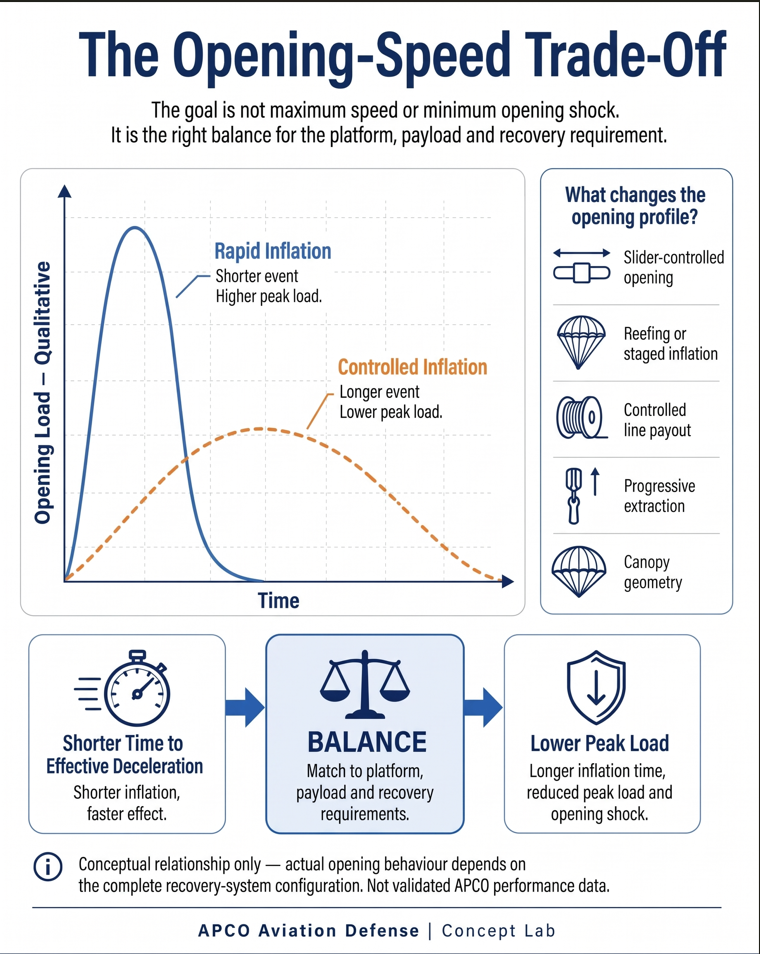
The available source material supports the relationship between inflation time, opening control and opening load, but does not support using one universal performance curve for all systems.
Faster Is Not Automatically Better
The experiment therefore should not aim for the fastest possible parachute.
It should aim for the fastest useful recovery sequence that remains compatible with the asset being preserved.
That distinction matters. A parachute could technically inflate extremely quickly but produce forces that require heavier reinforcement in the canopy, stronger attachment structures or additional protection for the payload.
The cruciform technical material specifically notes that excessive opening shock can drive structural changes that add weight and volume to the parachute system.
That creates another engineering loop: Faster opening → Higher load → More reinforcement → More weight and volume
So optimizing only one parameter can create problems elsewhere. The better solution may come from looking at the recovery system as a whole.
Opening speed, inflation behavior, canopy geometry, line behavior, platform strength, payload sensitivity, available altitude, system weight and packed volume all influence one another.
The goal is more than just maximum performance in one direction – it’s the right balance for the mission.
Opening-control Solution: What Good Looks Like
A successful opening-control solution should not be judged only by how quickly the parachute becomes fully inflated.
The engineering team should be able to confirm that:
- The parachute extracts and presents correctly.
- Suspension lines extend in the intended sequence.
- Useful deceleration develops within the available recovery height.
- Opening loads remain compatible with the UAV structure.
- Attachment points remain within their defined limits.
- The payload is not exposed to unacceptable force or secondary movement.
- The parachute structure remains within its design limits.
- The system transitions into a stable recoverable descent.
- The critical asset reaches the ground in the return condition defined for the project.
That is what turns opening-shock control from a parachute characteristic into part of critical asset preservation, payload protection and survivability.
Why APCO Aviation Defense
APCO Aviation Defense works at the meeting point of two different worlds of aviation textile solutions.
Experience from sports aviation brings years of learning about lightweight textiles, parachutes, deployment, handling and safety. Experience from UAV recovery brings a different set of requirements around platforms, payloads, integration and mission needs.
APCO’s background in sports aviation is also directly connected to the lightweight, low-bulk construction and opening-shock control used in its UAV recovery work.
Bringing those two knowledge bases together creates more ways to look at the same engineering problem.
That combination is especially relevant to APCO Aviation Defense UAV recovery textile solutions, where the answer has to fit the real platform, payload, attachment points, deployment condition and required return condition.
In aviation defense textile solutions, having experience from different fields can make a real difference.
Instead of starting every challenge from zero, ideas and lessons from one field can help identify new directions in another—supporting more creative solutions and potentially reducing the time, development effort and cost needed to reach the right answer.